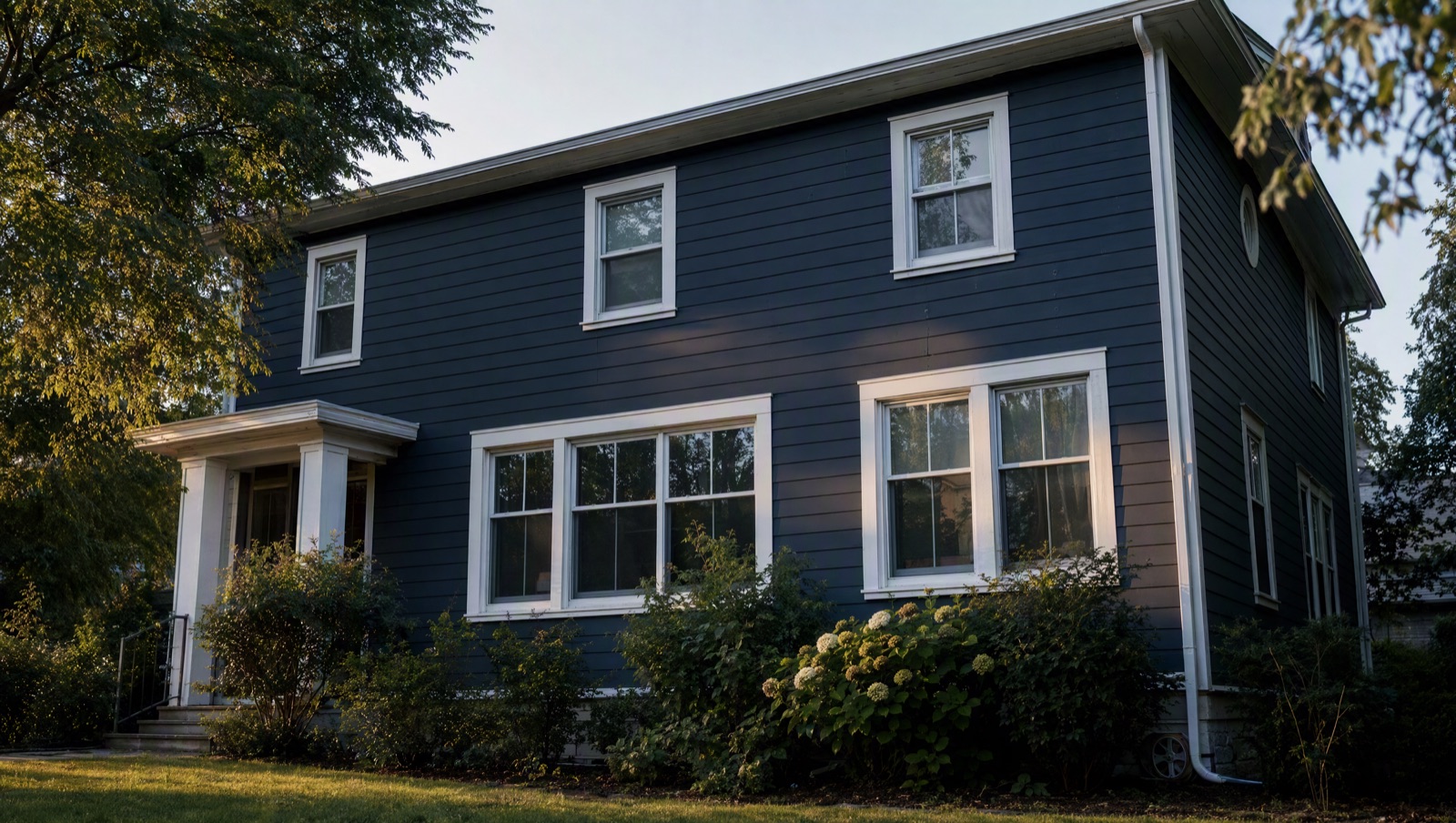
A two-storey home clad in deep navy lap siding with crisp white corner boards and window casings, photographed from the front lawn at golden hour.

SIDING · UPSTATE NEW YORK

Siding Installation

An exterior system that protects the house and lifts how it looks — installed by crews who treat the details as the job.

5.0★ on Google Licensed & Insured

Get a Free Estimate

Honest answers. No pressure.

Thank you — your request is in. We’ll be in touch shortly.

Licensed & Insured

Licensed & Insured
Manufacturer Certified
Workmanship Warranty
20+ Years of Craftsmanship

What a Siding Installation Includes

Eight things happen on every replacement we build. None of them is an upgrade added later.

A roofing quote is only comparable to another roofing quote when both of them say what is actually in the job. Two numbers on two pieces of paper can be a thousand dollars apart and describe completely different roofs — one with new flashing at every penetration and a membrane in the valleys, one without. So here is ours, in the order it happens, from the morning the tarps go down to the afternoon we walk the lawn with a magnet.

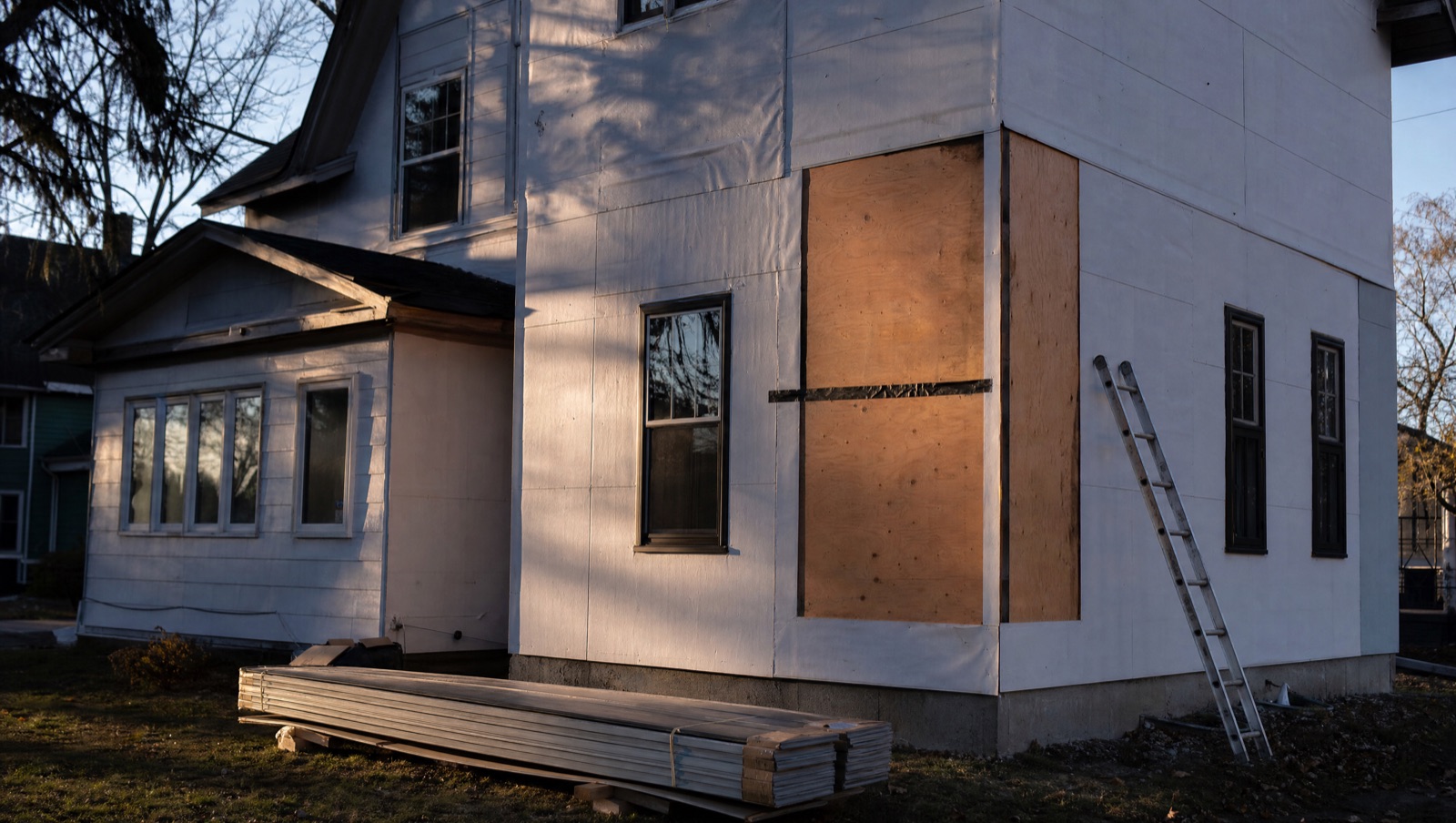
A house elevation with the old siding stripped away and plain house wrap being hung over the bare sheathing, bundles of new siding stacked on the lawn.

Every panel comes off, down to the sheathing. Going over the top of old siding hides exactly the things you are paying us to find — soft sheathing, failed wrap, water tracking behind a window — and it adds a layer that traps whatever moisture is already in the wall.

It is more work and it is the only way to know what you actually have. The wall gets opened, looked at, and photographed before anything new goes on it.
With the old siding gone the sheathing is exposed and we walk it. Soft spots, delamination, old patch jobs and rot around windows all show up at this stage and nowhere else.

Anything unsound gets cut out and replaced before the wall is closed up. We show you what we found and what it costs before we do it — no one likes a surprise line item, least of all us.

House wrap is the layer that actually keeps water out of your wall, and almost nobody quotes it properly. It has to be lapped shingle-fashion so water runs over each seam rather than into it, taped at the joints, and tied into the flashing at every window and door.

Wrap installed badly is worse than no wrap at all, because it channels water inward and holds it there. This is the layer we are most particular about.

Rigid foam under the siding does two things: it adds R-value across the whole wall rather than just between the studs, and it gives the siding a flat, continuous plane to sit on.

It is not right for every house and we will tell you when it is not worth the cost. Where it is specified, it goes on square and taped.

The accessories decide whether the finished wall looks straight. The starter strip sets the angle for every course above it, so it gets levelled rather than eyeballed. Corner posts and J-channel go on before the field so every panel has somewhere clean to die into.

Get these wrong and no amount of care on the field panels will save the look of the wall.

Siding moves. A twelve-foot panel can grow and shrink most of a quarter inch between a January night and an August afternoon, so it is nailed in the centre of the slot, snug but not tight, with room to run at the ends.

Nailed hard and butted tight — which is how a rushed crew does it — the wall buckles the first hot week. This is the single most common failure we are called out to fix.

Windows, doors, corners, the soffit and the fascia are where the eye actually goes, and where water gets in if the details are lazy. Head flashing over openings, sealed penetrations, and returns that close properly rather than being caulked shut.

This is the part of the job you will look at every day for twenty years.

Tarps go down before the tear-off starts — along the walls, over the beds, and across whatever sits below. Old siding goes into the truck as it comes off, not at the end of the week.

When the work is done we run a magnet over the lawn, the driveway and the walkways, then walk it with you. A finished job has to look finished on the ground as well as on the wall.

The Layers, From the Sheathing Out

Seven things sit between your studs and the weather. Most quotes name one of them.

A wall is not a panel. It is an assembly, and every layer in it has one job that the layer outside it depends on. Read the seven below and you will be able to tell, in about ninety seconds, whether the estimate on your kitchen table describes an exterior system or just a covering.

1 2 3 4 5 6 7
The assembly, drawn
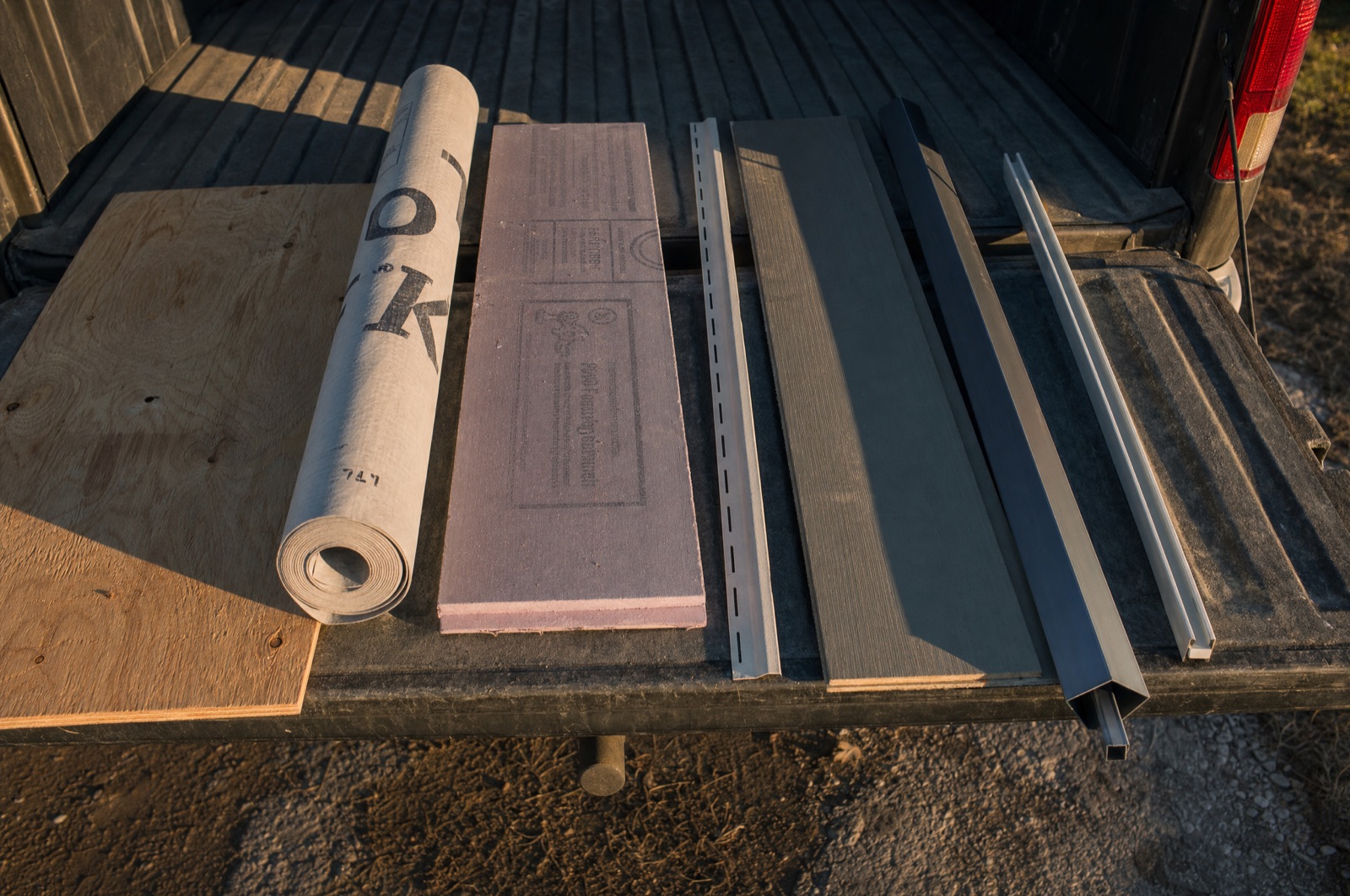
Siding materials laid out in order on the open tailgate of a work truck: sheathing, house wrap, foam board, a starter strip, lap siding, a corner post and J-channel.
Layer samples on the tailgate
1

Sheathing

The plywood or OSB skin nailed across the studs. It carries every fastener that holds the wall together, so a siding job is only ever as good as the wood nobody sees. Soft sheathing gets cut out and replaced.

2

Weather-Resistive Barrier

House wrap, lapped shingle-fashion so water runs over each seam rather than into it, taped at the joints and tied into the flashing at every opening. This is the layer that actually keeps the wall dry.

3

Insulation Board

Rigid foam adds R-value across the whole wall rather than just between the studs, and gives the siding a flat continuous plane to sit on. Specified where it earns its cost, not by default.

4

Starter Strip

A levelled strip at the base of the wall. It sets the angle for every course above it, which is why it gets a level rather than an eyeball. A crooked starter shows up forty feet up the wall.

5

Lap Siding

The visible course, each panel overlapping the one below and nailed in the centre of its slot — snug, never tight. Siding grows and shrinks with the season; pinned hard, it buckles the first hot week.

6

Corner Post & J-Channel

The profiles every panel terminates into. They go on before the field so nothing has to be cut to fit at the end. Get these wrong and no amount of care on the field will save the wall.

7

Trim, Soffit & Fascia

Windows, doors, corners and the eave line. Head flashing over every opening, sealed penetrations, returns closed properly rather than caulked shut. This is the part you look at every day.

Repair or Replace

Not every wall that worries a homeowner needs new siding. Some do. Here is how we tell them apart.

This is the question underneath almost every call we take, and it is the one a contractor has the most to gain from answering wrongly. So we will answer it the way we would want it answered for our own house. A wall earns its re-siding. Until it has, a targeted repair is cheaper, faster and completely legitimate — and we will say so.

When to Repair

Usually the right call when the problem has an address: one place, one cause, and a wall that is otherwise doing its job.

  • A few cracked or broken panels you can point to
  • The siding is comfortably inside its service life
  • The wrap and sheathing behind it are dry and sound
  • Storm damage took a defined area rather than a whole elevation
  • Colour is still even across the wall, not chalking
  • Trim is solid everywhere you press it

When to Replace

Usually the right call when the wall has stopped failing in one place and started failing as an assembly.

  • Cracking, warping or buckling across whole elevations
  • Colour has gone chalky and paint will not hold it
  • Trim or sheathing is soft, or rot shows around openings
  • Heating bills have climbed with no other explanation
  • Moisture or mould is appearing on inside walls
  • Panels rattle or lift in wind, or the siding is past 25–30 years

Signs It Is Time to Have Someone Look

Warped or buckling panels

Chalk on your hand when you touch it

Soft spots in trim or around windows

Paint failing on wood trim within a year or two

Daylight or draughts at inside exterior walls

Panels that rattle or lift in wind

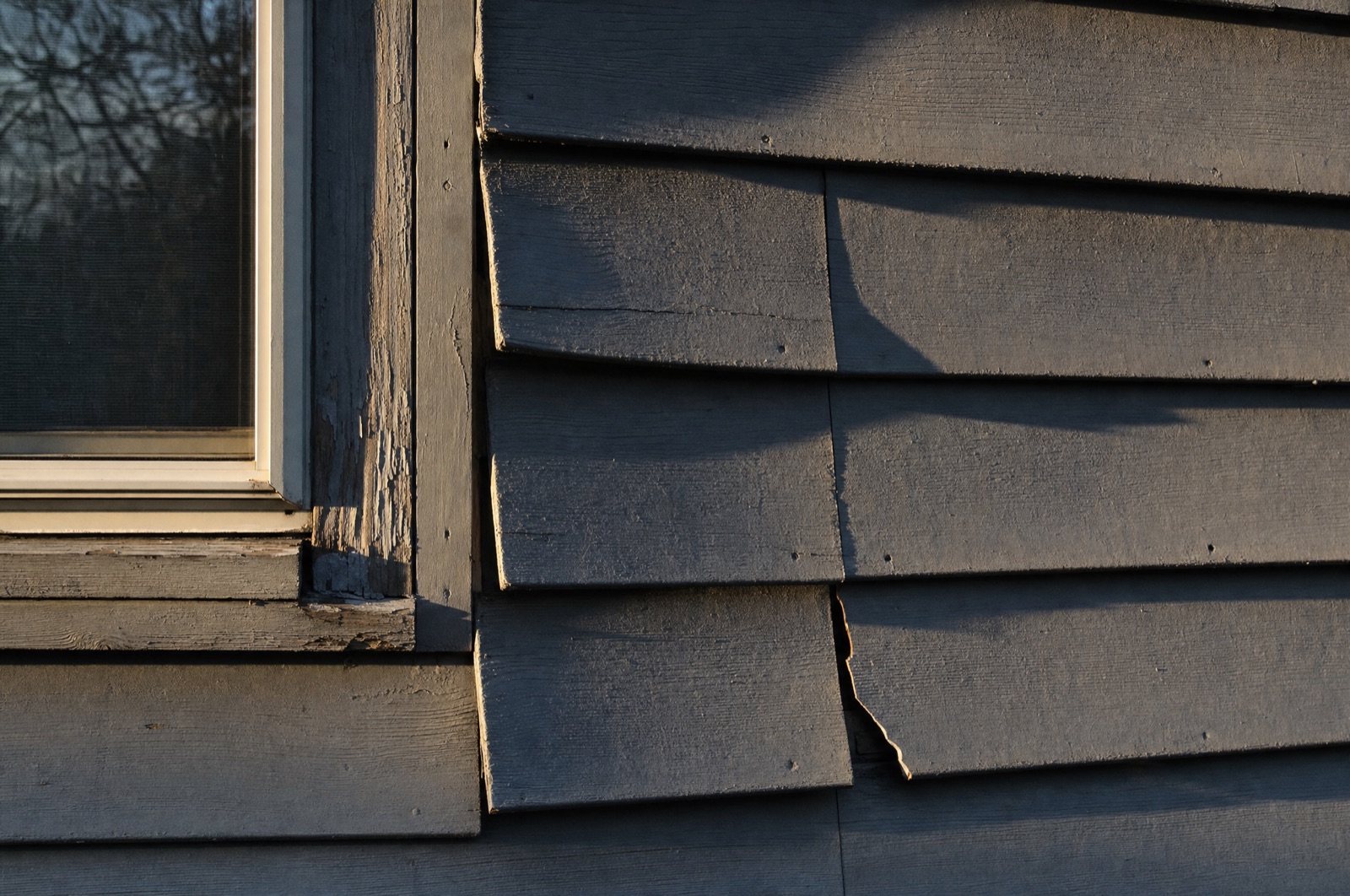
Failing siding in low raking light: panels warped and buckling away from the wall, colour gone chalky and uneven, an opened butt joint and soft grey trim at the window edge.

If a repair is the right answer, we will tell you that — and then we will do the repair. If a full re-side is the right answer we will show you why, on your wall, in photographs, before you are asked to decide anything. What we will not do is turn one bad valley into a new roof because the new roof is the bigger job.

Have Us Look Before You Decide.

An inspection costs nothing and it ends the guessing. We will walk the whole exterior, check the trim and the seams around every opening, and look behind a panel where we can — then tell you what your siding actually needs, including if the answer is nothing yet.

(585) 204-0822

Book an Inspection

Honest answers. No pressure.

Thank you — your request is in. We’ll be in touch shortly.

Licensed & Insured

Materials and What Stands Behind Them

Two guarantees sit on a finished roof: the manufacturer's, and ours.

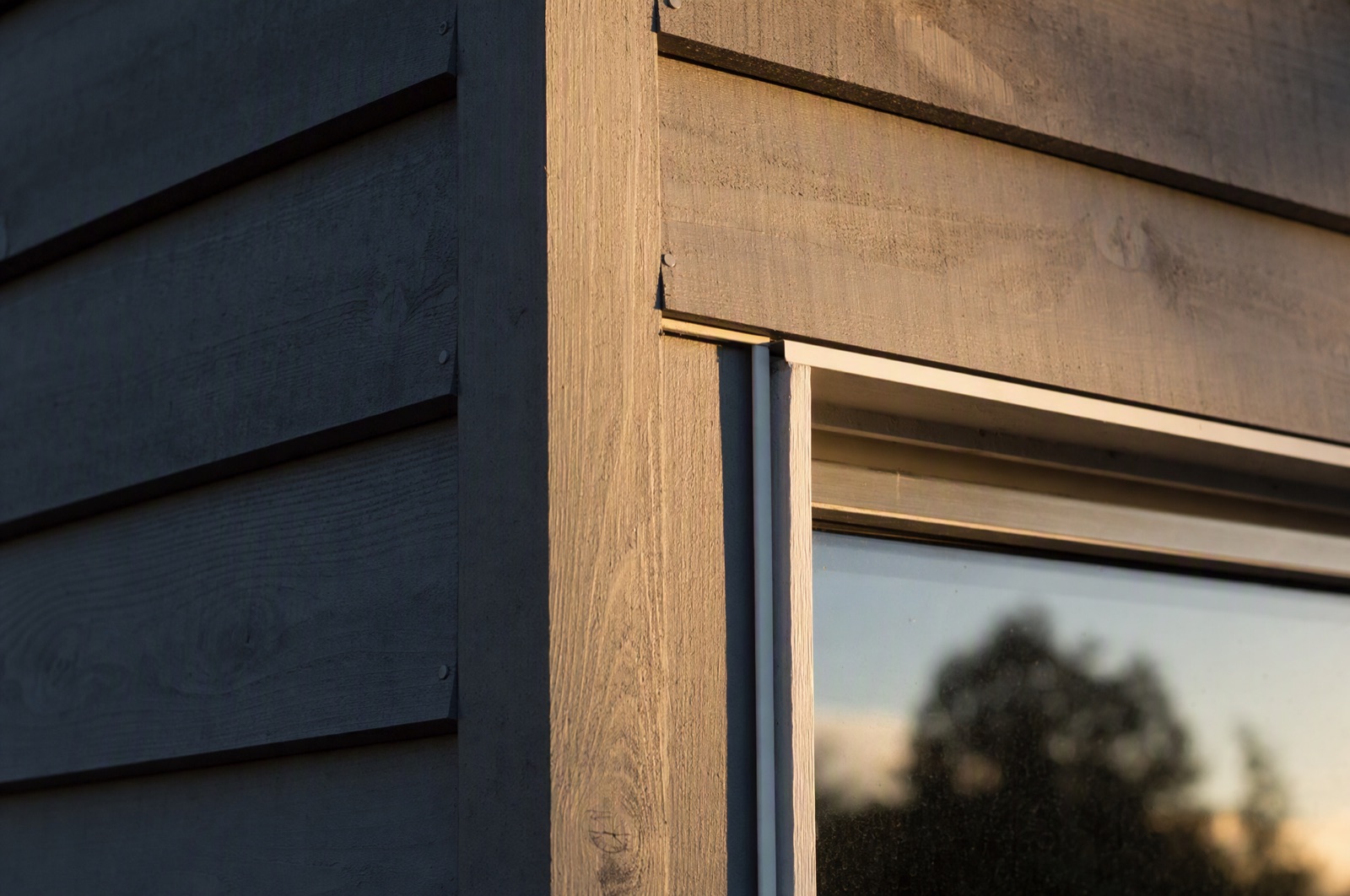
Finished siding detail where a wall meets a window: crisp white J-channel running the casing, a corner post catching the sun, lap courses stepping cleanly into it.

We install manufacturer-certified materials, which means the components on your roof are designed to work as one assembly and are installed to the pattern their maker specifies — starter, field, hip and ridge, ventilation and all.

It matters more than the brand on the bundle. A premium shingle installed over the wrong starter, without the right underlayment, or above an attic with no exhaust is a premium shingle ageing early.

Materials carry the manufacturer's own coverage. The installation carries ours: a workmanship warranty, in writing, handed to you at the final walkthrough alongside the product paperwork.

Both documents go in the same envelope on the same day, so you are never left holding a roof and wondering who to call. If something we installed is not right, we come back and put it right.

Built Right. Backed by Integrity.

Rated 5.0★ on Google. Homeowners, in their own words.

20+Years of Craftsmanship
5.0★On Google
Free EstimatesNo Pressure, No Obligation
Licensed & InsuredUpstate New York

“What really stood out to me was the detail in their metal work — everything from the trim to the flashing was clean, precise, and done the right way. You can tell they don’t cut corners.”

Ilmi C. · Google review

“Their communication was excellent throughout the entire process — we were always informed about what was happening and when. No surprises and no stress, which really sets them apart.”

Antjuan B. · Google review

“The crew was top tier. Super respectful, hardworking, and clearly experienced. They treated our home like it was their own and kept everything clean and organized throughout the job.”

Nileidys V. · Google review

Where We Work

Roof replacements across Upstate New York — Monroe, Wayne, Ontario and Seneca counties, and the towns between them.

AltonAuburnBrockportCanandaiguaChurchvilleClifton SpringsClydeFairportFarmingtonGenevaHenriettaHiltonHoneoyeHoneoye FallsLyonsMacedonManchesterMarionMonroe CountyNewarkNorth RoseOntarioOntario CountyPalmyraPenfieldPhelpsPittsfordPort GibsonRochesterRomulusRoseSavannahSeneca CastleSeneca CountySeneca FallsShortsvilleSodusSodus PointSpencerportStanleySyracuseVictorWalworthWaterlooWayne CountyWebsterWest HenriettaWilliamsonWolcottYork

Questions We Are Asked Most

Answered the way we would answer them at your kitchen table.

Q1How long does a siding job take?

The honest answer is that it depends on the house: its size, how many gables and dormers, how much trim there is around windows and doors, and what we find once the old siding is off. A straightforward single-storey elevation can be a couple of days. A large two-storey with a lot of detail runs a week or more.

What we can promise is that you will have the expected number of working days in writing before the crew arrives, and that if it changes you will hear it from us rather than notice it yourself.

Q2Will you tear off the old siding or go over it?

We tear it off. Going over the top of existing siding is faster and cheaper, and it is why we do not do it: it buries the sheathing and the wrap, and buries whatever is wrong with them along with it.

It also adds a layer that can trap moisture in the wall. If a contractor quotes you an over-side, ask what happens to the water that gets behind it. The answer is the reason we take the old siding off.

Q3What happens if you find rot behind the old siding?

Sometimes we do. Water gets in around a window or a failed lap in the wrap and it does not announce itself until the wall is open. When we find it, work stops on that elevation and we show you — in photographs, on your house, before anything else happens.

You get the cost of putting it right before we do the work, not on the final invoice. Nobody enjoys that conversation, but everybody prefers having it early.

Q4What about my landscaping and gardens?

It gets protected before anything comes off the wall. Tarps go down along the foundation and over the beds, and old siding goes into the truck as it comes off rather than piling up on your lawn.

At the end we run a magnet across the lawn, the driveway and the walkways for fasteners, then walk the site with you before we leave.

Q5Will the new siding match my existing trim and windows?

That is part of the conversation before anything is ordered. Sometimes the trim is sound and the right move is to match to it. Sometimes the trim is the thing that has actually failed, and re-siding around it is money spent to make an old problem less visible.

We will tell you which one you are looking at, and show you the colour and profile against the house in daylight rather than off a chip in a truck.

Q6Do you handle insurance claims?

Storm damage often turns into an insurance question, and we are used to that conversation. We will document what we find and give you a clear scope you can hand to an adjuster.

We will talk it through with you and be straight about what we think it amounts to. We will not tell you a claim is worth filing when we do not believe it is.

Q7How soon can you come look?

Call (585) 204-0822 and we will get you on the calendar. If water is getting into the house we will treat it as urgent rather than fitting it into the queue.

The inspection itself is free, and it comes with photographs and an explanation whether or not you go ahead with us.

Still holding a question this page did not answer? Ask us directly

Let's Protect Your Home.

Honest answers. No pressure. Start with a free estimate.

More from Noble Edge